Updated Author Guidelines and Manuscript Template for BJNHS
The Editorial Team has updated the Author Guidelines and Manuscript Template to improve manuscript quality, reporting standards, and compliance with international publishing practices.
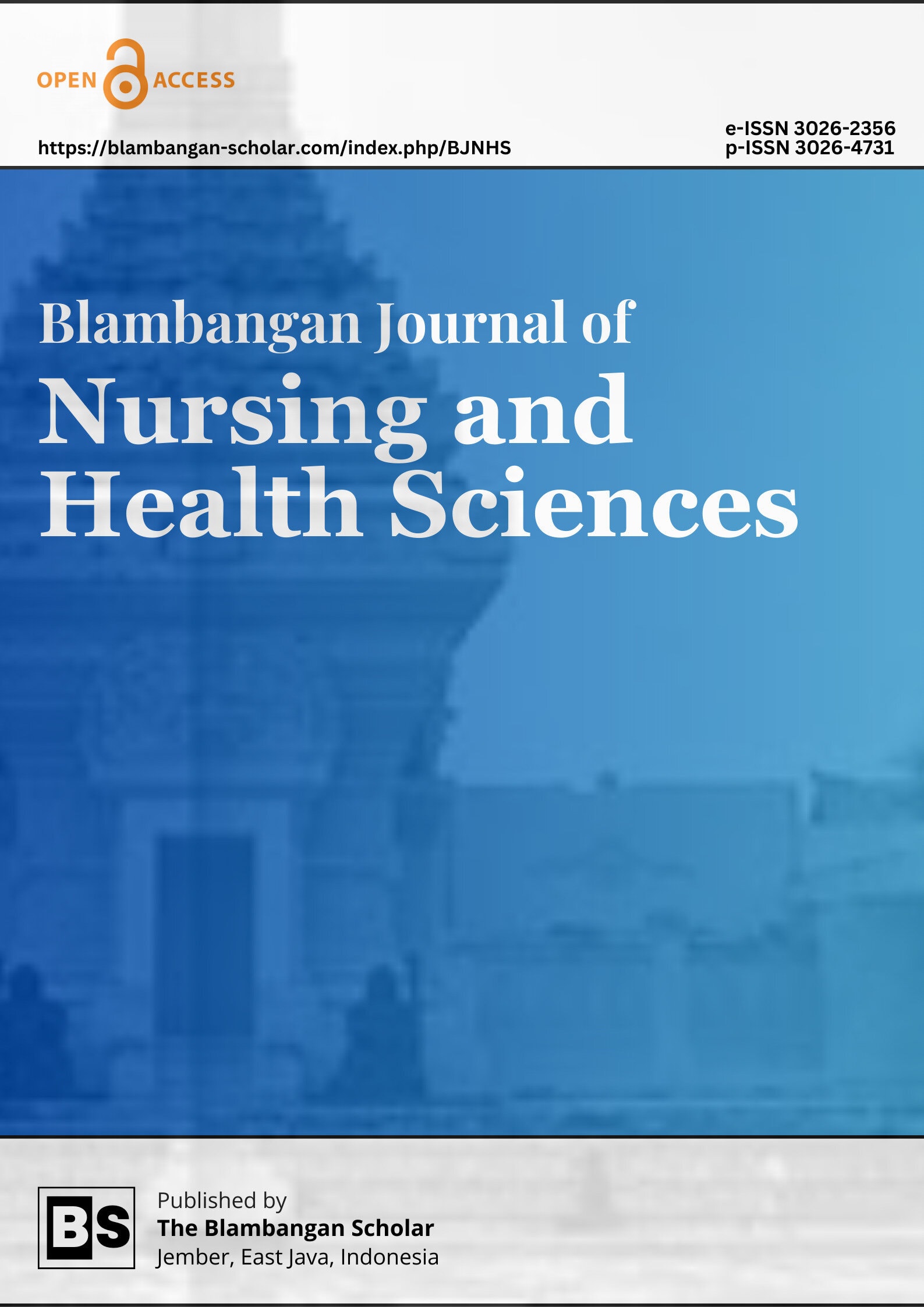
Blambangan Journal of Nursing and Health Sciences (BJNHS) is a peer-reviewed, open-access journal dedicated to publishing high-quality research that advances nursing and health sciences. The journal welcomes original research, reviews, and other scholarly contributions across nursing, midwifery, pharmacy, medical laboratory technology, public health, and interdisciplinary health sciences. BJNHS promotes research that strengthens clinical practice, professional education, healthcare management, health systems, public health, and evidence-based healthcare. Committed to scientific excellence, research integrity, and rigorous peer review, the journal serves as a global platform for disseminating reliable, innovative, and impactful research that improves healthcare practice, policy, and patient outcomes.
The Editorial Team has updated the Author Guidelines and Manuscript Template to improve manuscript quality, reporting standards, and compliance with international publishing practices.

BJNHS invites experienced international scholars to join our Editorial Board.
BJNHS invites qualified international scholars and researchers to join our Reviewer Panel.
This editorial reflects on the direction of scholarly publishing in nursing and health sciences, emphasizing the importance of meaningful contribution over publication quantity. It outlines the journal’s commitment to academic quality, contextual relevance, and scholarly integrity.
Background: Physical changes are almost always followed by changes in behavior and attitudes. The main problem experienced by adolescents is ignorance of the behavior that must be carried out in conenection with the changes experienced, especially the problem of adolescent knowledge about reproductive health and how adolescent behavior in dealing with these changes
Aims: The purpose of this study is to analyze the relationship between reproductive health knowledge and the behavior of adolescents aged 10-12 years facing physical changes.
Methods: This research design uses analytical with a cross sectional analysis approach. This study uses a quantitative approach. The population of this study was all students in grades IV and V with a total sampling technique and a sample size of 87 respondents. Data collection used an instrument in the form of a questionnaire filled out by the respondents themselves. The data are presented in tabular form. Data analysis in this study was bivariate analysis with the selection of statistical test through SPSS software using spearman..
Results: The results showed that 32 respondents (39%) had good knowledge and behaved positively. The lowest respondents had less knowledge and behaved negatively as many as 5 respondents (5,7). The results of the analysis using spearman rho obtained a sig (2-tailed) of 0,008, which means there is a strong relationship between knowledge and behavior in dealing with physical changes, namely p-value <0,05.
Conclusion: there is a relationship between the level of knowledge of reproductive health and the behavior of adolescents aged 10-12 years facing physical changes.
Background: Type 2 diabetes mellitus is a chronic condition that can adversely affect patients’ physical, psychological, and social well-being. Beyond clinical management, psychological factors such as self-motivation and self-esteem may influence how patients manage their condition and perceive their quality of life. However, evidence regarding the relationship between these factors and quality of life among patients receiving care at community health centers remains limited.
Aims: To determine the associations of self-motivation and self-esteem with quality of life among patients with type 2 diabetes mellitus at Pasar Minggu Community Health Center, South Jakarta.
Methods: A quantitative analytical cross-sectional study was conducted among patients with type 2 diabetes mellitus at Pasar Minggu Community Health Center, South Jakarta. From a population of 159 patients, 114 respondents were selected using simple random sampling. Self-motivation, self-esteem, and quality of life were assessed using the Treatment Self-Regulation Questionnaire, Rosenberg Self-Esteem Scale, and Diabetes Quality of Life Questionnaire, respectively. Data were analyzed using the Chi-square test with a significance level of p < 0.05.
Results: Among the 114 respondents, 40 (35.1%) had low self-motivation, 59 (51.8%) had low self-esteem, and 61 (53.5%) reported low quality of life. Self-motivation was significantly associated with quality of life (p = 0.022). Self-esteem was also significantly associated with quality of life (p = 0.002), with an odds ratio of 3.409.
Conclusion: Self-motivation and self-esteem were significantly associated with quality of life among patients with type 2 diabetes mellitus. These findings highlight the importance of addressing psychological factors alongside clinical management to support quality of life among patients with type 2 diabetes mellitus in primary healthcare settings.
Background: Auditory hallucinations are a common and distressing symptom of schizophrenia that can disrupt patients’ behavior, cognitive functioning, and daily activities. Nursing management generally includes hallucination-control strategies and pharmacological treatment, while complementary cognitive interventions may provide additional support for symptom management.
Aims: This case study aimed to describe the implementation of comprehensive nursing care incorporating crossword puzzle therapy for a patient with auditory hallucinations at Bali Provincial Mental Hospital.
Methods: A descriptive case study was conducted involving a 36-year-old female patient diagnosed with paranoid schizophrenia and experiencing auditory hallucinations. Data were collected through interviews, physical examination, behavioral observation, and medical and nursing record review. Nursing care was implemented based on the Indonesian Nursing Intervention Standards (SIKI), including hallucination management and four patient implementation strategies (SP1-SP4). Crossword puzzle therapy was administered once daily for 15-20 minutes over five consecutive sessions. Patient responses and progress were documented throughout the intervention.
Results: At baseline, the patient reported auditory hallucinations occurring 1–2 times daily, lasting approximately five minutes, and was observed pacing, mumbling, and demonstrating a flat affect. During the intervention, the patient progressively required less assistance in completing the crossword puzzles. By the fourth and fifth sessions, she was able to complete the exercises independently and reported improved ability to control the hallucinations. At the final evaluation, the patient appeared calm and cooperative, no longer demonstrated pacing or self-talk, and reported a substantial reduction in hallucination frequency.
Conclusion: The integration of crossword puzzle therapy into comprehensive psychiatric nursing care was associated with improved cognitive engagement, greater independence in completing therapeutic activities, and reduced reported auditory hallucination symptoms in this case. Crossword puzzle therapy may represent a feasible complementary intervention within psychiatric nursing practice. Further studies involving larger samples and controlled designs are needed to determine its effectiveness.
Background: Choking occurs due to a blockage in the airway, either totally or partially. Choking on children can be dangerous condition and life threatening if it is not prevented and treated immediately. Parents’ ability to handle choking is determined by their knowledge. To determine the effect of audio-visual method toward mothers’ knowledge in preventing and managing choking at Banjar Dalem, Songan B Village.
Aims: This study aimed to determine the effect of audio-visual education on mothers’ knowledge of preventing and managing choking in children in Banjar Dalem, Songan B Village.
Methods: This study employed pre-experimental design with the one group pretest posttest. There were 38 respondents recruited as the samples which were chosen by using purposive sampling technique. The data were collected by using knowledge questionnaire which was given before and after intervention. The data were analyzed by Wilcoxon rank test.
Results: The results showed that there were significant differences between mother’s knowledge before and after being given education by using audio-visual (p-value ≤ 0.05). Before the intervention, it was found that 33 respondents (86.8%) had poor knowledge. After the intervention was given, 38 respondents (100%) had good knowledge.
Conclusion: Education through audio-visual media can be considered as a mean to improve mother’s knowledge about handling choking on children
Background: Primary dysmenorrhea is a common menstrual health problem among adolescent girls and may interfere with daily activities and school participation. Nutritional status has been proposed as a modifiable factor associated with menstrual symptoms; however, evidence regarding its relationship with the severity of primary dysmenorrhea among adolescents remains limited.
Aims: To determine the association between nutritional status and the severity of primary dysmenorrhea among adolescent girls at MA Nuris, Jember, Indonesia.
Methods: This study employed a descriptive correlational design with a cross-sectional approach. The population comprised 79 female students in Grade XI at MA Nuris, with 44 participants selected using purposive sampling based on the Slovin formula. Nutritional status was assessed through body weight and height measurements to determine body mass index, while dysmenorrhea severity was assessed using the Numeric Rating Scale. Data were analysed using frequency distributions and the Spearman correlation test.
Results: Most participants had normal nutritional status (28, 63.3%), followed by overweight (9, 20.4%) and underweight (7, 16.3%). Regarding dysmenorrhea severity, 26 participants (59.0%) experienced mild symptoms, 13 (29.6%) moderate symptoms, and 5 (11.4%) severe symptoms. Nutritional status was significantly associated with the severity of primary dysmenorrhea (p < 0.001).
Conclusion: Nutritional status was significantly associated with the severity of primary dysmenorrhea among adolescent girls at MA Nuris. These findings support the importance of promoting balanced nutrition as part of adolescent menstrual health education and reproductive health programmes.
Keywords: adolescents; primary dysmenorrhea; nutritional status; menstrual health; reproductive health


Published by:
THE BLAMBANGAN SCHOLAR
Jember, East Java, Indonesia
Whatsapp: +6282244142345
E-mail: bjnhs.scholar@gmail.com
![]()
BJNHS is licensed under a Creative Commons Attribution-ShareAlike 4.0 International License